Crazy Legs
An influential Rock Steady Crew dancer who helped carry breaking to international audiences.
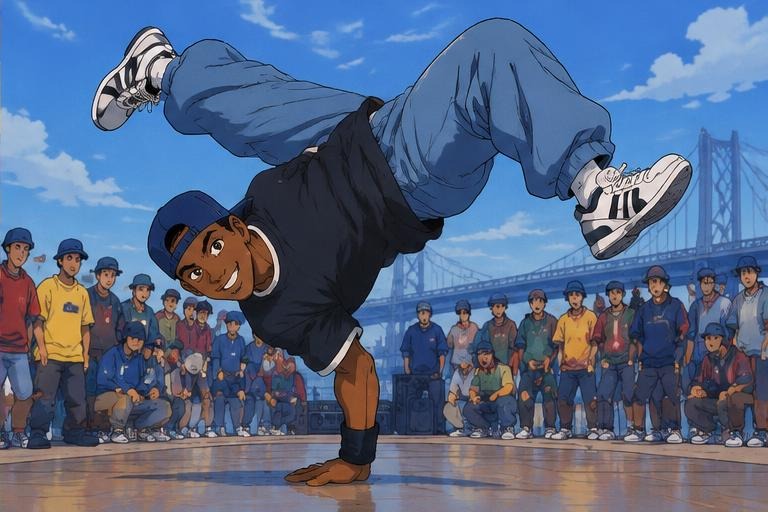
Breaking / 1980s
Known within the culture as breaking, this dance turns a musical break into a conversation of style and movement.
Breaking grew in the Bronx around the musical passages DJs extended for dancers. B-boys and b-girls answered the beat with individual style. “Breakdancing” became a widely used media term, while many practitioners prefer “breaking.” The dance is inseparable from the music and social spaces that gave it life.
The cipher—a circle with space for dancers at its center—makes performance an exchange. Someone enters, offers a phrase and leaves room for a response. Attention moves between the dancer, DJ and people around the circle. A move gains meaning through timing and context, not only through difficulty.
Toprock is the upright dancing that often establishes a dancer’s rhythm and attitude. Downrock or footwork develops closer to the floor, using hands and feet to create patterns and changes of direction. Power moves emphasize momentum, rotation and athletic control. Freezes hold a position, often punctuating a musical accent or completing a phrase.
These categories overlap in actual dancing. Transitions connect them, and a personal vocabulary makes familiar movements feel distinctive. Musicality means interpreting the music’s structure and texture—not simply executing a sequence while a track happens to play. A well-placed pause can communicate more than an uninterrupted string of tricks.
Rock Steady Crew and Dynamic Rockers are important names in breaking’s history. Dancers such as Crazy Legs and Ken Swift helped demonstrate its expressive and technical range. Battles, tours and films carried the dance to audiences who had not experienced a Bronx cipher firsthand.
Electric Boogaloos also shaped the wider history of hip hop-associated street dance, particularly popping and boogaloo. Those forms have distinct West Coast histories and should not be collapsed into breaking. Respecting the culture includes learning the differences between related dances instead of placing every movement under one label.
Breaking can demand strength, mobility, coordination, endurance and balance. Gradual training, warm-ups and rest are part of the craft, not obstacles to it. Skilled guidance is especially important for moves that place weight on the wrists, neck or shoulders. Beginners do not need dangerous power moves to contribute a meaningful round.
Battles can channel competition into artistic exchange, but they do not automatically eliminate conflict. Organizers and dancers have to build respectful conditions: clear expectations, fair judging, safe floors and room for people of different experience levels. Competitive intensity and personal dignity can coexist.
Breaking communities developed across Europe, Asia, Latin America, Africa and elsewhere, bringing their own musical choices and training cultures. International battles connect those scenes, but everyday sessions and local crews sustain the dance between major events.
Breaking made its Olympic debut at Paris 2024. That recognition introduced the form to new audiences while raising questions about judging, institutional control and the balance between sport and culture. The Olympic stage is one chapter, not the definition of breaking. Its living foundation remains the dancer responding to music in conversation with other people.
Give the pioneers their flowers
An influential Rock Steady Crew dancer who helped carry breaking to international audiences.
A New York crew whose performances and film appearances helped introduce breaking to audiences around the world.
Upright steps that establish rhythm, character and musical connection before floorwork.
Floor-based footwork supported by hands and feet.
A controlled held position that punctuates a dancer’s movement or a musical accent.
A circle where dancers take turns exchanging movement, energy and individual expression.
Follow the movement
What did your first dance circle teach you?
@planet4elementsThe Planet 4 Elements dispatch
Hip hop stories, pioneer spotlights and fresh perspectives on the four elements.
Planet 4 Elements · Each one, teach one.