MC Solaar
Helped bring French-language rap to wide audiences with wordplay, storytelling and jazz-inflected music.
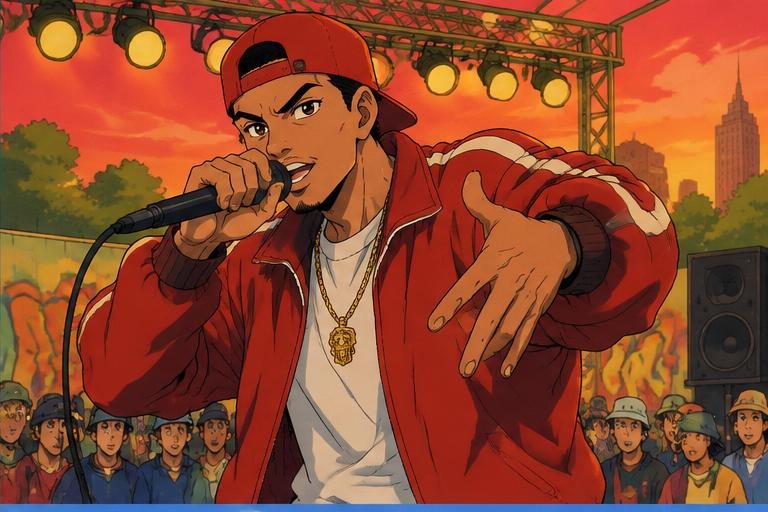
MCing / 1990s–today
A shared set of creative tools became thousands of local stories—and an ongoing conversation about identity, power and belonging.
Hip hop traveled through records, touring, migration, film, radio and personal exchange. Later, online video and social platforms accelerated those connections. It did not arrive everywhere as a single, unchanged package. People selected, translated and reworked its practices in relation to their own lives.
The four elements offered tools that could be practiced at different scales: a rhyme in a local language, a dance circle, a carefully selected set or letters in a sketchbook. A shared vocabulary made exchange possible without requiring every community to tell the same story.
In France, artists such as IAM and MC Solaar helped establish distinctive approaches to language, narrative and identity. In Brazil, Racionais MC’s gave powerful expression to life and inequality in São Paulo’s peripheries. These scenes developed their own audiences and debates rather than simply following American trends.
Japanese hip hop and breaking communities built distinctive performance and production networks. South Africa’s Prophets of da City and later artists connected hip hop with local languages and the changing political landscape. Senegalese rap, including Positive Black Soul, joined musical innovation with public conversation. Each example opens a regional history that deserves study on its own terms.
Hip hop has offered language for challenging racism, inequality and exclusion, but no genre guarantees a single political position. Artists can express resistance, humor, faith, ambition or pleasure; scenes can also reproduce the hierarchies they criticize. Listening carefully means attending to those tensions instead of turning every performer into a symbol.
International jams and collaborations create opportunities to learn across borders. Genuine cultural exchange depends on more than borrowing a sound: it asks who is credited, who is paid and whose voice shapes the collaboration. A shared beat can begin a conversation, but mutual respect keeps it going.
Hip hop’s influence reaches fashion, advertising, technology and a large global music economy. Artists have built labels and businesses, while brands have profited from styles developed in communities with far fewer resources. Commercial success creates possibilities, but ownership, compensation and control remain central questions.
Teachers and scholars also use hip hop to explore poetry, history, media literacy and social questions. Hip hop pedagogy is strongest when it treats the culture as knowledge, not as a gimmick for making a lesson entertaining. In 2018, Kendrick Lamar received the Pulitzer Prize for Music for DAMN., a landmark recognition of rap’s artistry alongside decades of community-based learning and critique.
Online communities can connect people who would never meet at the same local jam. A persistent profile lets a member share their interests and build a record of contributions. Posts and comments can exchange technique, local histories and creative work. Following another member can turn a first encounter into an ongoing relationship.
Those opportunities require care. Screening harmful text, allowing reports and documenting moderation decisions can help maintain standards, but tools do not replace fair judgment or generous participation. Credit sources, seek permission before sharing someone else’s work and challenge an idea without attacking its author. Hip hop’s future is not only about what becomes popular; it is also about what communities choose to make possible together.
Give the pioneers their flowers
Helped bring French-language rap to wide audiences with wordplay, storytelling and jazz-inflected music.
The São Paulo group made Black Brazilian life, inequality and social critique central to its influential work.
Brought hip hop influences into Korean pop on a global scale, with early work rooted in rap and dance performance.
Reworking a cultural form through local languages, histories and everyday experience, rather than simply copying it.
Communities and cultural connections formed as people move from ancestral homelands into other places.
A shared circle for exchanging verses or movement; a space for listening as well as performing.
Follow the movement
Introduce the cipher to an artist from your city, in any language.
@planet4elementsThe Planet 4 Elements dispatch
Hip hop stories, pioneer spotlights and fresh perspectives on the four elements.
Planet 4 Elements · Each one, teach one.